
Documentation Index

Fetch the complete documentation index at: https://docs.eat-now.io/llms.txt

Use this file to discover all available pages before exploring further.

All of the agent’s settings live in Settings → AI Agent. The page is split into clear cards, each with its own Save button — change one card and save it without touching the rest. On the right, a test panel lets you try your changes immediately. This page walks through each card.

Activation

Controls whether the agent is allowed to answer at all.
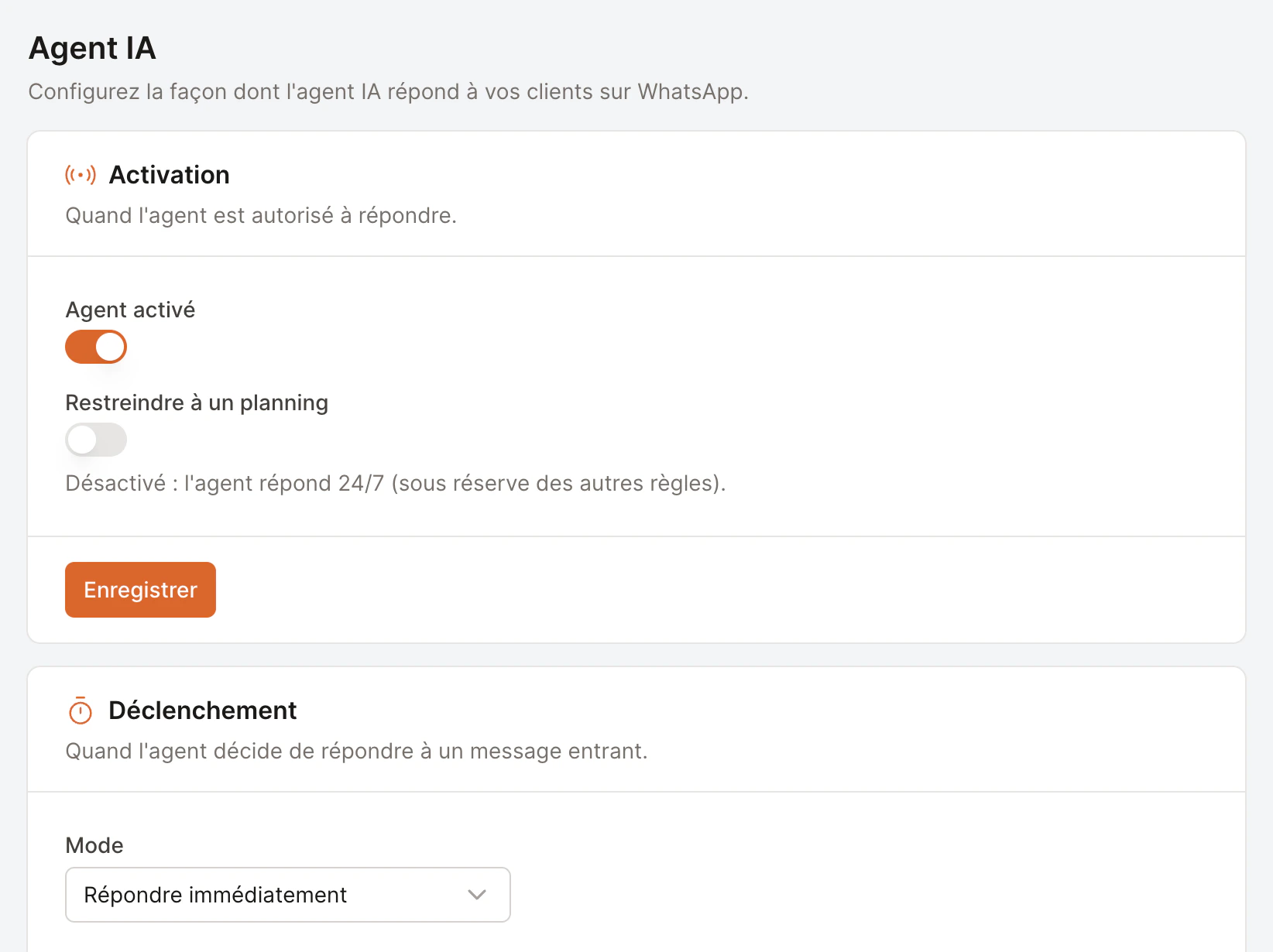
The Activation card with the enable toggle and the schedule option
SettingWhat it does
Agent enabledThe master switch. Off = the agent never replies, whatever else is configured.
Restrict to a scheduleOff: the agent answers 24/7. On: it only answers during the time slots you add (e.g. Friday 12:00 → 23:59). Add as many slots as you like.
Most restaurants leave the schedule off — replying at 2am is exactly where the agent shines. Use a schedule only if you specifically want the agent quiet outside certain hours.

Trigger

Controls when the agent jumps in once a message arrives.
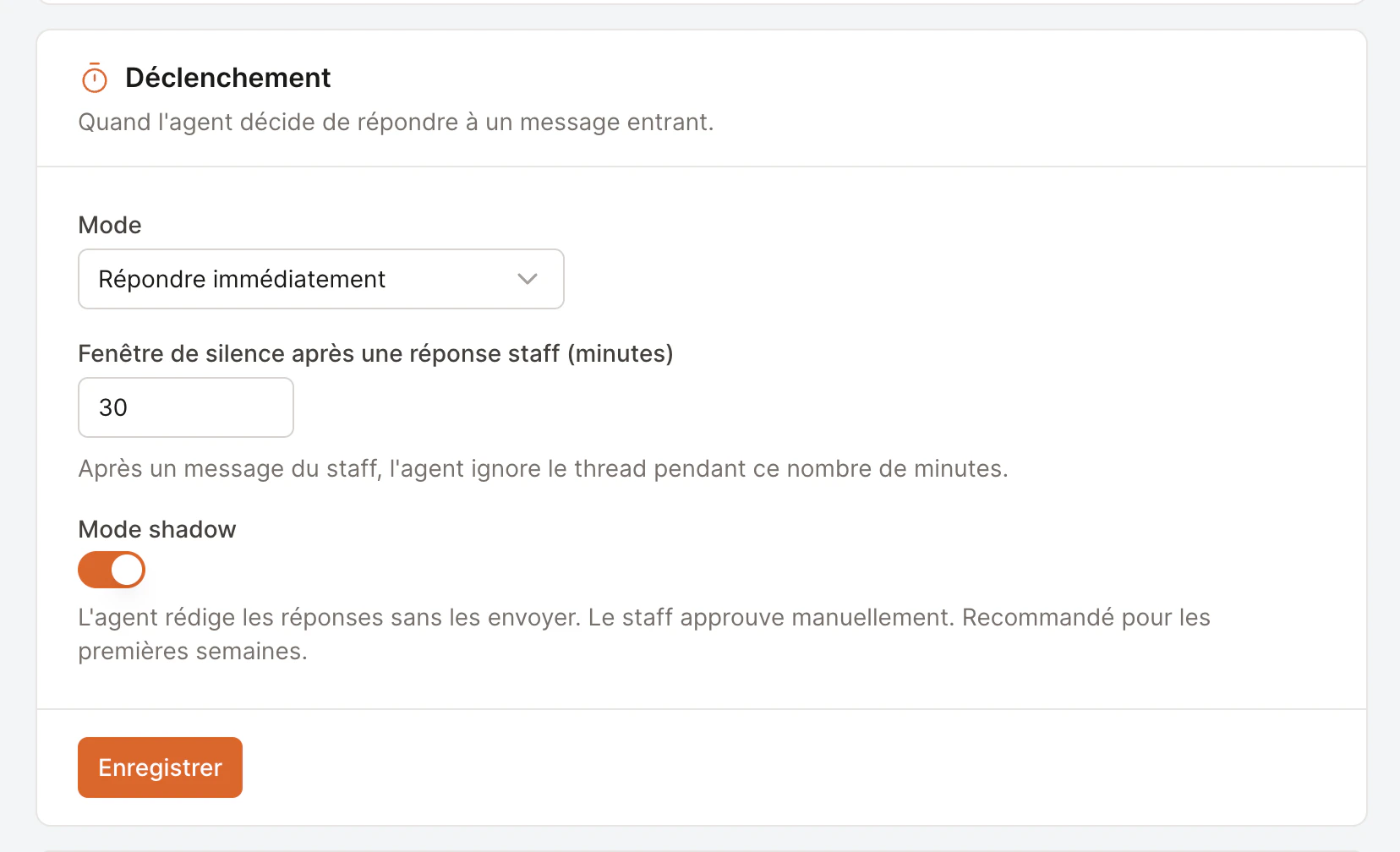
The Trigger card with reply mode, silence window and shadow mode
SettingWhat it does
Mode → Reply immediatelyThe agent answers right away.
Mode → Reply only if staff hasn’t replied within…The agent waits the number of minutes you set. If a team member replies first, the agent stays quiet. Great if you’d rather answer in person when you can, and only let the agent cover what you miss.
Silence window after staff replyAfter any team member sends a message, the agent leaves that conversation alone for this many minutes (default 30). It won’t talk over you.
Shadow modeWhen on, the agent drafts replies for you to approve instead of sending them. More below.

Shadow mode

This is the single most important setting when you’re starting out.

Shadow mode ON

The agent writes a reply but doesn’t send it. It appears in your inbox as a draft to approve, edit, or reject. Nothing reaches a customer without your say-so.

Shadow mode OFF

The agent sends replies directly. You can still jump into any conversation to take over — the agent steps back as soon as you do.
We recommend keeping shadow mode on for the first couple of weeks. It lets you see exactly how the agent handles your real customers before trusting it to reply on its own.

Persona

Controls how the agent sounds to your customers.
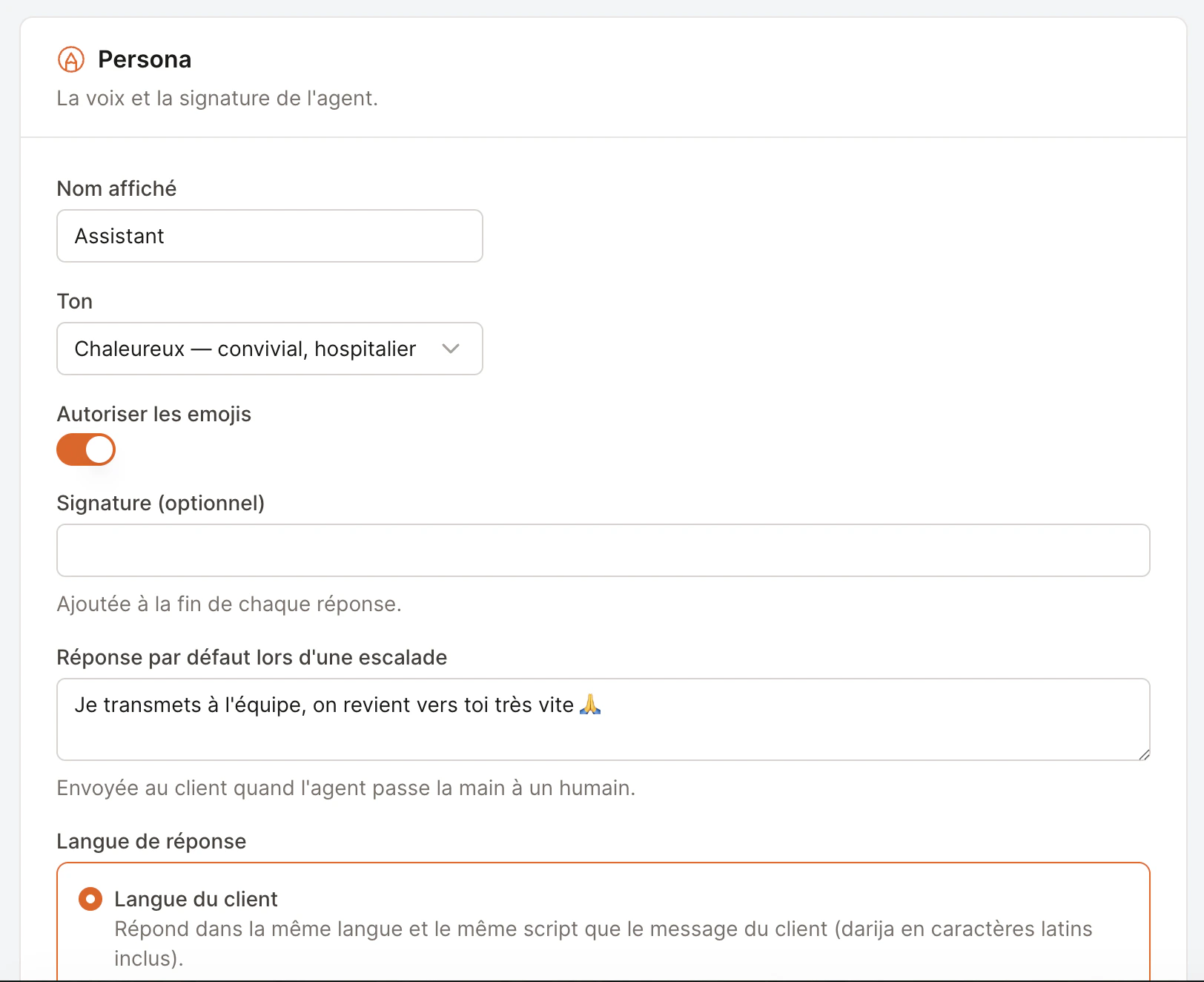
The Persona card with name, tone, emojis, signature and reply language
SettingWhat it does
Display nameThe name the agent uses if it introduces itself (e.g. “The Petit Jardin assistant”).
ToneWarm (conversational, hospitable), Formal (respectful, no slang), or Concise (efficient, minimal).
Allow emojisWhether replies can include emojis. Turn off for a more buttoned-up style.
SignatureOptional text added to the end of every reply, e.g. ”— Le Petit Jardin 🌿”.
Default reply when escalatingWhat the agent says to the customer when it hands off to your team. Keep it warm and reassuring.
Reply languageHow the agent picks a language — see below.

Reply language

Match the customer

Recommended. The agent replies in the same language and script as the customer — including Darija written in Latin letters. If they switch languages mid-chat, the agent follows.

Custom rules

You write your own policy in plain language, e.g. “If the customer writes in Darija or French, reply in French. Otherwise reply in English.” The agent follows it on every reply.

What the agent can do

Each toggle gives the agent permission for one type of action. Anything you turn off is completely invisible to the agent — it can’t do it and won’t mention it.
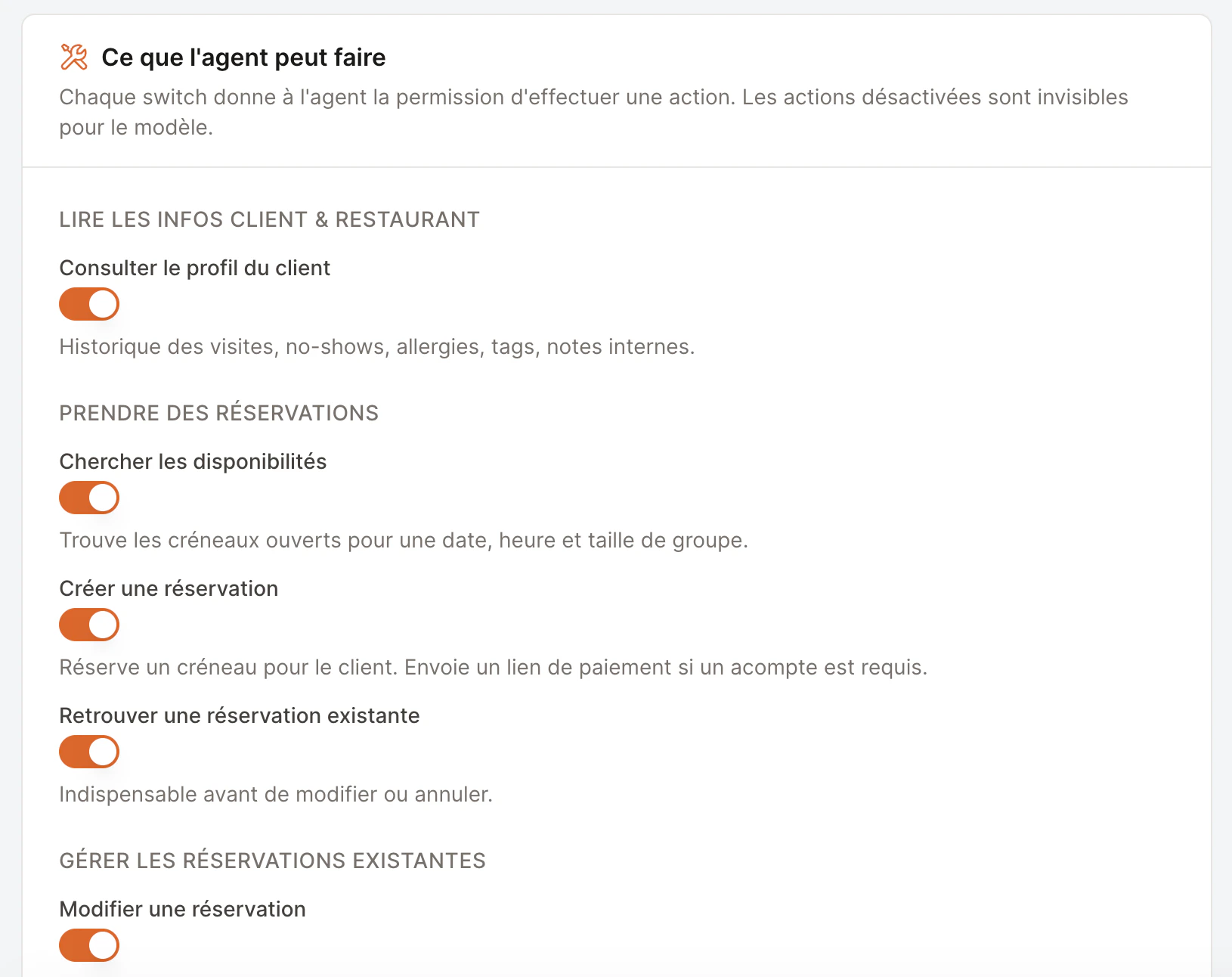
The capabilities card with grouped toggles
Read customer & restaurant info
  • Look up the customer’s profile — past visits, no-shows, allergies, tags, internal notes, so it can greet regulars properly.
Take new reservations
  • Search availability — find open slots for a date, time, and party size.
  • Create a reservation — book a confirmed slot. Sends your payment link automatically if a deposit is required.
  • Find an existing reservation — required before it can modify or cancel anything.
Update existing reservations
  • Modify a reservation — proposes the change, asks the customer to confirm, then applies it.
  • Cancel a reservation — confirms with the customer first, then cancels.
  • Append a note to a reservation — adds a table preference, occasion, or late-arrival heads-up for your team (never overwrites existing notes).
Conversation flow
  • Hand off to staff — lets the agent bow out gracefully when unsure. Always recommended.
  • End the conversation silently — for when a customer just says “thanks, bye”.
Keep Hand off to staff enabled. It’s the agent’s safety valve — without it, an unsure agent has no clean way to step back and bring in a human.

Credits

In the top-right of the page you’ll see your credit balance (e.g. 240 credits left). Credits are how agent usage is metered — each reply uses a small amount. The badge turns orange when you’re running low and red at zero. Learn more in Safety & controls → Credits.